

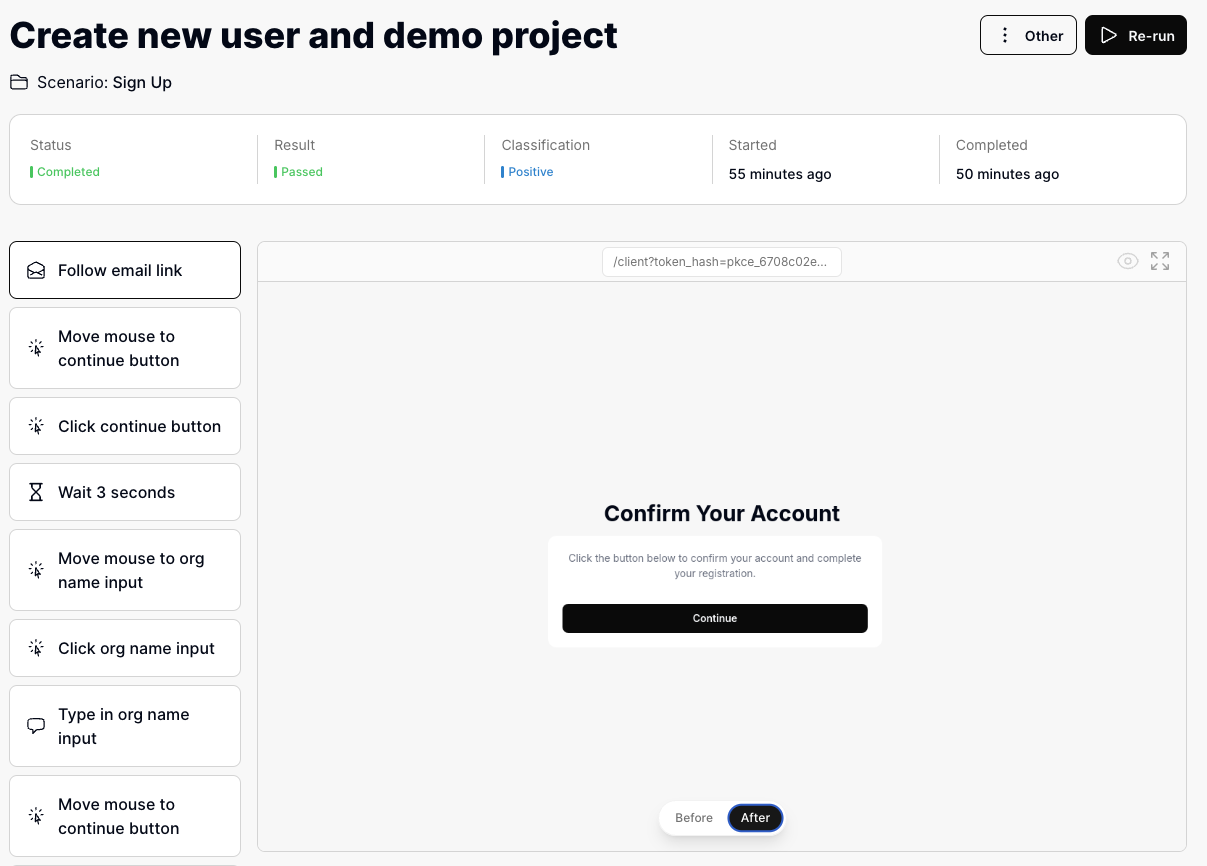
- Account verification
- Password reset flows
- Email notifications
- Newsletter subscriptions
How It Works
The inbox feature is powered by a direct integration with our email backend. When a test step requires checking email (e.g., “Wait for the welcome email”), the agent queries the inbox system directly.- Polling: The agent polls for new emails for up to 3 minutes. If no matching email is found within this time, the step fails.
- No Pagination: The system always looks for the newest email that matches your criteria. It does not support pagination or “get more” requests.
- Text-Only View: The agent sees a text summary of the email (subject, match reason, attachment summary), not the raw HTML or JSON.
What the Agent Can Do
The agent interacts with the inbox in three specific ways:Filtering & Matching
To find the right email, the system uses strict filtering and natural language matching:- Recipient: Emails are strictly filtered by the
to_address. The agent only sees emails sent to the specific address configured for the test. - Content Matching: The agent uses your natural language query (e.g., “password reset email”) to match against the subject, body, and attachments.
- Time Window: The system enforces a strict time cursor based on when the test run started.
- The agent can only see emails received after the test execution began.
- Emails received before the test started are invisible to the agent.
Email Configs
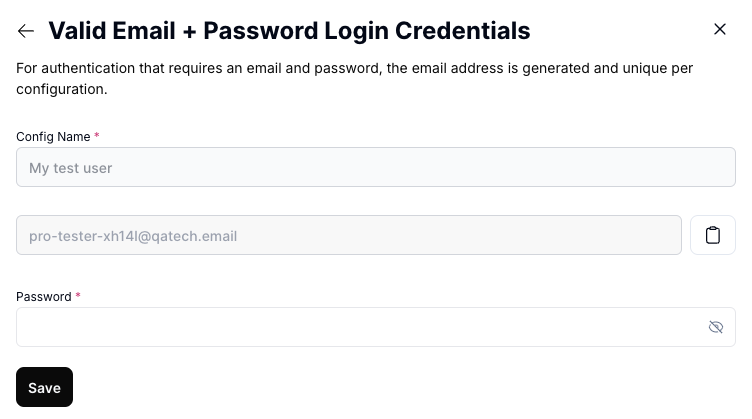
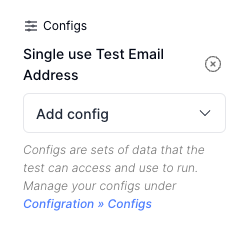
QA.tech provides these system email configurations by default:- Single use Test Email Address - New generated email for each test (can be re-used by having another test depend on the first)
- Project e-mail address - Static email always accessible for the project
- Navigate to Settings » Configs
- Select “Email Inbox” type
- Configure the email settings
- Save the configuration
- Add the config to your test case settings
Supported Email Types
The inbox feature only works with emails managed by the QA.tech system.Whitelisting Email Addresses
If your application restricts which email addresses can sign up, receive mail, or pass spam filters, you need to allow QA.tech test addresses. Whitelist the@qatech.email domain. All QA.tech-generated test addresses and all outgoing emails from QA.tech use this domain. Allowing the whole domain covers every address your tests may use, including:
- Project emails (
prj-xxxxx@qatech.email) - Magic link login emails (
magic-login-xxxxx@qatech.email) - Single-use addresses generated per test run (for example,
test-automation-abc123@qatech.email)
- Signup or registration restrictions — Allow
@qatech.emailso test accounts can be created. - Email server or gateway filters — Allow inbound mail to
@qatech.emailso verification, password reset, and notification emails reach the test inbox. - Spam or security tools — Allow outbound mail from
@qatech.emailso messages sent by QA.tech are not blocked or quarantined.
For a stable address you can add to a fixed allowlist, use a Fixed /
Project email config. Single-use addresses change on every run, so they are
harder to pre-approve.
Using Email Inbox in Tests
- Create or edit a test case
- Under the Settings tab, select the email config to use
- The test will now have access to the email inbox
Writing email flows
When writing tests that involve emails (account resets, invitations, notifications):- Specify the recipient: Mention the target address in the goal or step (for example, “Wait for the welcome email sent to
user@example.com”). - Use descriptive queries: Describe the email clearly (for example, “Find the email with subject ‘Reset your account’”).
- Mind the time window: Tests only see emails received after the test started.
- If Test A triggers an email and finishes, Test B cannot see that email if it starts afterwards.
- Combine the trigger and verification into one test, or use dependencies where the second test triggers a resend.
Manual Access
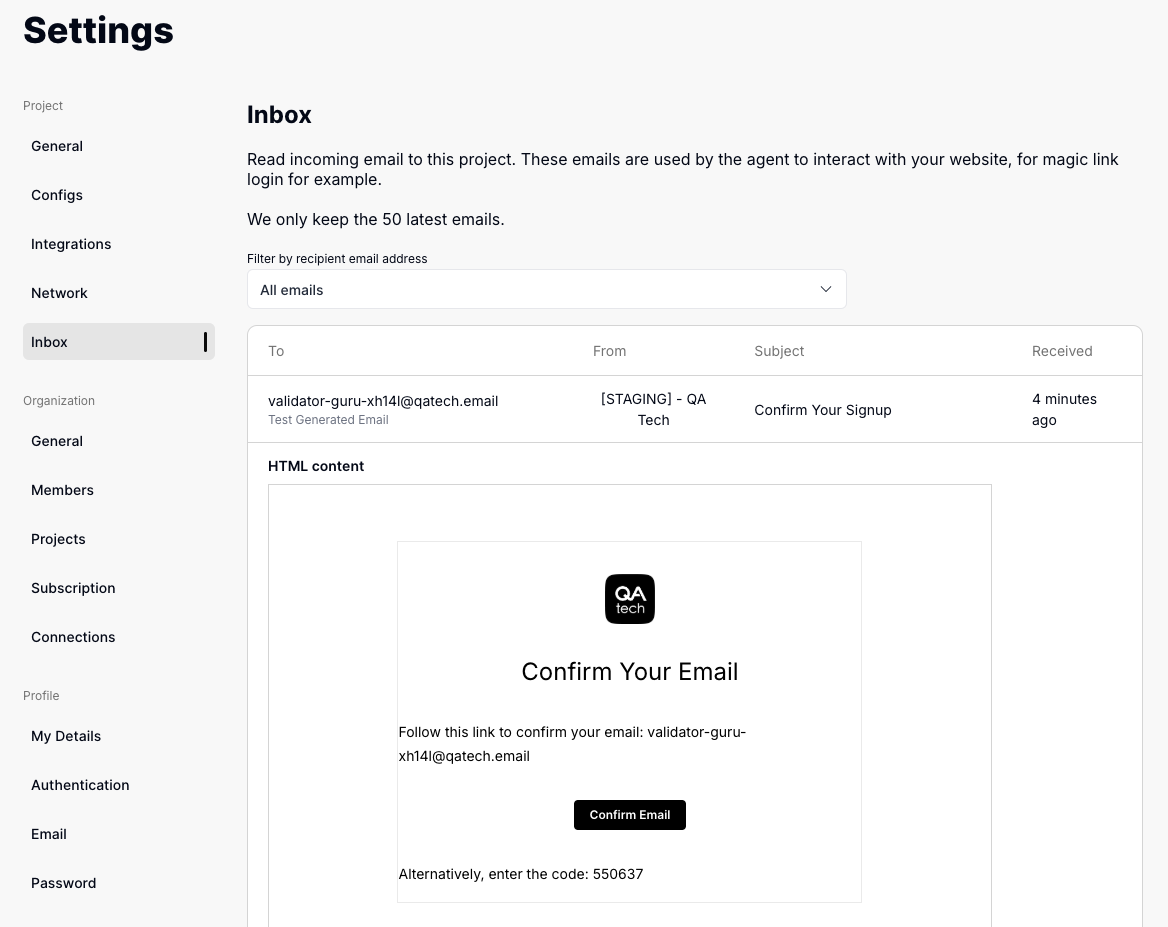
You can view test emails manually:- Go to Settings → Inbox
- View all received test emails
Important Considerations
- Shared Inboxes: If multiple tests use the same email inbox simultaneously (e.g., two password reset tests), emails may get mixed up. Use separate email configs for concurrent tests.
-
Sharing Emails Between Tests: If Test B needs to check an email triggered by Test A:
- Output Values: In Test A, save the email address as an Output Value. In Test B, use that value to tell the agent which inbox to check.
- Shared Configs: If using a Fixed/Project email, both tests can use the same config. Be mindful of the time window (Test B must start before the email arrives, or you must trigger the email during Test B).
-
Cross-Test Limitations: Because of the strict time window, a test cannot see emails that arrived before it started.
- If Test A triggers an email and finishes, and then Test B starts and tries to read that email, Test B will fail to find it.
- Solution: Combine the trigger and verification into the same test, or ensure the email is triggered after the verification test starts (e.g., using dependencies where the second test triggers the resend).
-
Timeout: The agent will wait up to 3 minutes for expected emails before failing.
- Extending the wait: You can add explicit “Wait” steps (e.g., “Wait 2 minutes”) before the email check. Since the inbox cursor is fixed at the start of the test run, waiting before checking effectively extends the window for receiving emails.
- Invitation Links Since the browser state will be kept when opening the email you should log out after inviting a user to avoid that the invitation link redirects to the inviters account.